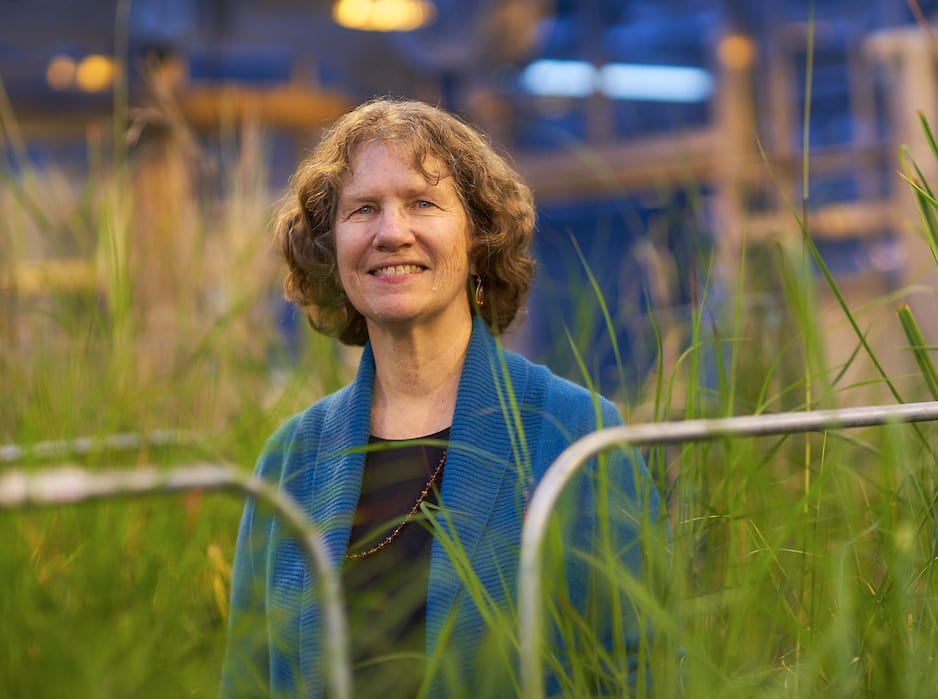
Molly Hanlon, PhD, wasn’t always interested in plants, but there were signs. Growing up in central Pennsylvania, she loved to be outdoors. She had a favorite shovel and a few John Deere tractor toys. She excelled at math and science. But she had limited exposure to the many different directions a career in science could take her. She started college as a pre-med student majoring in biochemistry, thinking that medicine was one of few paths she could pursue.
That all changed when she got a job on campus as a dishwasher in a plant physiology lab.
“I just kept showing up and taking on more tasks,” Molly explains. “The lab was having some issues with contamination in their mycorrhizal cultures, so I took a stab at it and was able to maintain the cultures without contamination. Some may think this would be due to impeccable sterile technique, but that was not the case. Our working hypothesis is that I would come to the lab immediately following swim practice in the morning and my fully chlorinated skin kept contaminants at bay. This one little achievement hooked me, and, once I came to the conclusion that going into medicine wasn't for me, there was no looking back.”
The Important Role of Roots
Molly says her interest in plants only deepens with time. She’s especially captivated by their resilience—like finding a tree anchored to a rock or weeds persisting through extreme weather.
She specializes in root biology, plant physiology, and plant-soil interactions. For almost twenty years, her work has been focused on better understanding roots—what features result in a root system that optimizes nutrient uptake and water usage, fueling the most productive crops? Recently, in addition to researching what makes roots most beneficial to a plant, she has also begun studying how roots can benefit soil—and how to balance the physiological needs of a developing root system, the needs of the plant as a whole, and the needs of the soil it lives in.
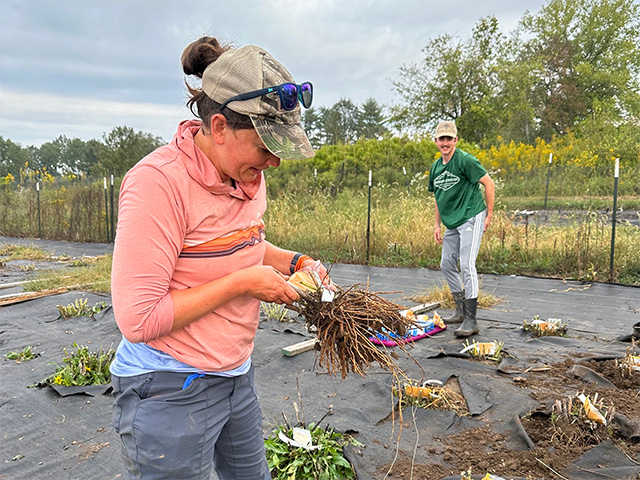
Because they are hidden away underground, roots are challenging to study. Molly has developed innovative tools to study root depth, architecture, and anatomy in the field. Through this research, she’s diving into some of the biggest questions for the future of agriculture.
“The cornerstone of my work is understanding and improving the fundamental process by which plants fix atmospheric carbon and move it into the soil through their roots, where biogeochemical processes have changed rock into soil—- how does a plant capture and allocate its carbon to result in highly productive, sustainable agroecosystems?” Molly says. “Agriculture of the future will require that we have high-yielding crops that are ecologically sustainable.”
Rooted in Purpose
Molly’s passion for plant science stems from her love of problem-solving. Because plants can’t tell us what they’re experiencing, she is drawn to the challenge of piecing together the stories of how they grow, adapt, and thrive. She also values the collaborative nature of the work.
“The best science comes from bringing together individuals with different backgrounds and expertise to solve incredibly complex problems,” she says. “I think that knowledge is the foundation of an enlightened society, and being able to work with others to generate that knowledge is incredibly rewarding to me. I am not going to singlehandedly solve the grand challenges of our generation, but I can contribute small bits of knowledge that move us all in that direction.”